
Beacon House review: A lens, a tide and one hour of power
Beacon House understands that pressure in a puzzle game does not need a monster or a countdown barked in your ear. Sometimes it is enough to stand in a lantern room above a rough coast and realise that every turn is burning through the only power you have left. This first-person coastal puzzler turns that simple idea into something wonderfully exacting. Across PC, PS5 and Xbox Series, it asks you to read sea conditions, interpret route clues and ration a failing generator while bringing a lighthouse back into useful alignment. The result is unusually focused, sometimes stern, and very nearly superb.
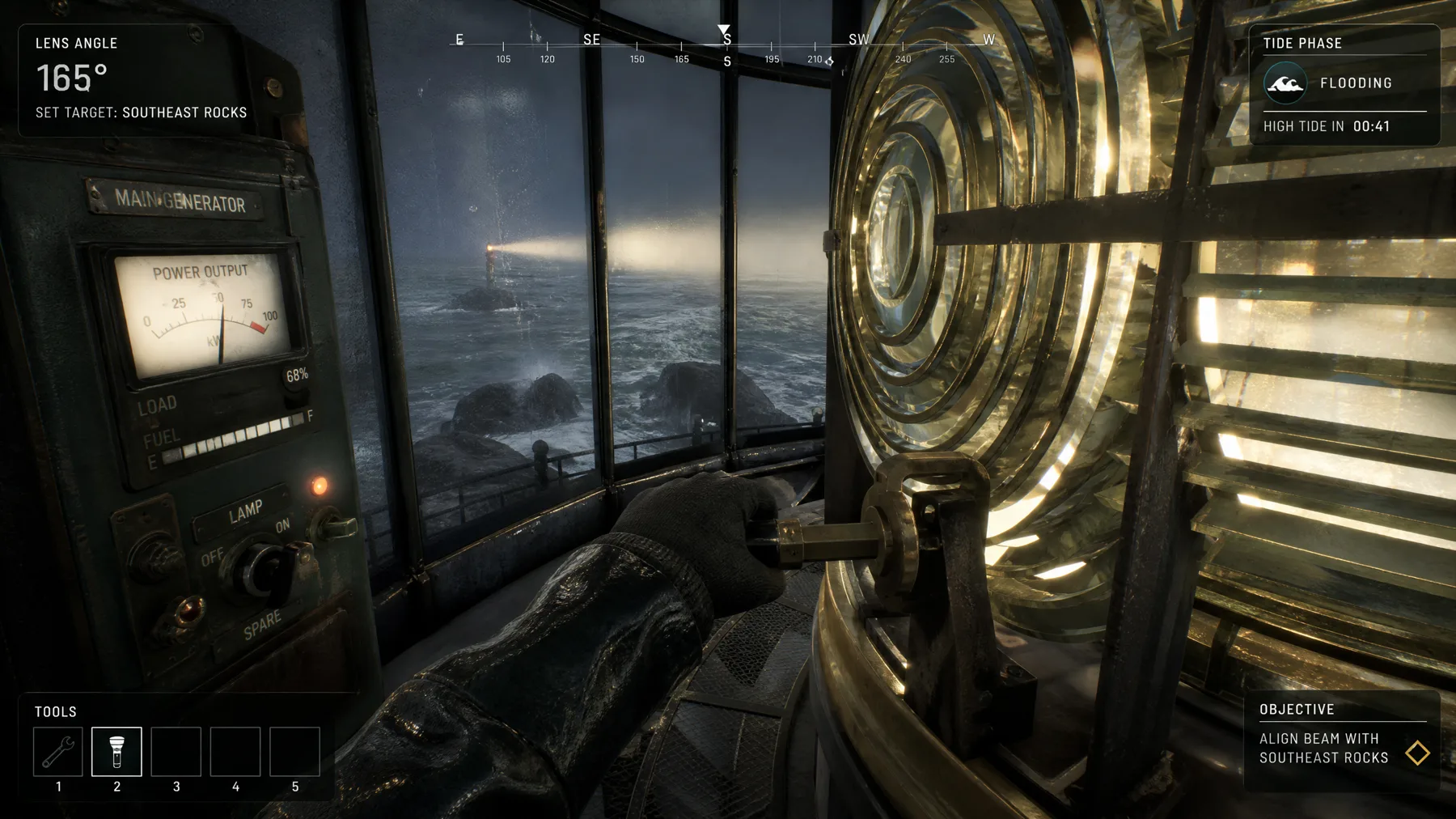
The key image tells you almost everything about the game. You spend a great deal of time rotating a heavy lighthouse lens while watching a concise HUD that tracks lens angle, tide phase, generator load, equipped tools and the next route objective. Beacon House is built around the relationship between them. Turning the lens is never an isolated action, because the correct angle only matters if a tide marker is currently visible, the route to reach the next point is still passable, and enough power remains to complete the sequence. It is a lovely knot of interdependent systems, and the pleasure comes from unpicking it cleanly.
Light as a physical puzzle
The lens mechanics are the game’s defining success. Rotation has weight, momentum and just enough resistance to suggest real machinery without becoming cumbersome. Instead of treating the lighthouse beam as a binary switch, Beacon House makes it a spatial instrument. You are matching angle, timing and line of sight, often across shifting weather and awkward sightlines, so each adjustment feels deliberate. Later puzzles build on the same foundation with admirable confidence. Some markers need the beam to pass through additional prisms. Others require partial alignment from one landing before a final correction from another.
Just as importantly, the game trusts the player to observe. The HUD gives numerical clarity, but it does not solve the riddle for you. You still have to notice when a marker sits slightly above the expected horizon line, or when a reflection suggests you should approach a lens lock from the opposite side. That balance between information and inference is difficult to strike. Beacon House gets it mostly right, which means mistakes are usually your own, and success has the satisfying click of proper understanding.
Tides, routes and the shape of each chapter
The coastal setting is not merely decorative. Tide phases reshape the playable space in ways that constantly affect decision-making. At low tide, rocks, service paths and maintenance platforms emerge, allowing you to reach secondary mechanisms or inspect damaged markers up close. At high tide, those same routes vanish or become dangerous, forcing you to rethink the order of tasks. This gives the game its distinctive cadence. A chapter is rarely about a single puzzle in a single room; it is about planning an efficient excursion through a place that will not stay still for your convenience.
The chapter structure uses that idea well. Early sections teach the language of the island: how to read the chart board, when to trust a painted route line, and why a seemingly obvious path may strand you if the sea turns while you are halfway along it. Mid-game chapters start combining inland maintenance spaces with exposed exterior routes, so you are switching between careful observation in close quarters and brisk decisions on the headland. The strongest late chapters ask you to create a chain of actions across several tide windows, then execute it with confidence before the generator forces compromise.
Rationing power without cheap punishment
The generator system is what turns Beacon House from a handsome puzzler into a tense one. Power drains as you rotate the main lens, activate exterior winches, restore local circuits or use heavier tools. Crucially, the game does not reduce this to simple stinginess. The best decisions are not always the most conservative ones. Sometimes it is worth spending extra load to reset a mechanism from inside the tower if that prevents a long walk through a rising tide. At other times, hoarding power early leaves you with too little information, causing wasteful backtracking later.
This also keeps the mood taut. Failure usually comes from an understandable cascade: a route misread leads to a delayed marker check, which forces a hurried lens correction, which burns the reserve needed for the final relay. That sort of collapse feels dramatically appropriate to the setting. It helps that restart times are brisk and checkpoints are sensibly placed at chapter boundaries or after major breakthroughs. Beacon House can be demanding, but it seldom feels malicious.
Controls, readability and practical play
In first-person puzzle games, small control flaws quickly become exhausting. Here, both mouse and pad handling are crisp enough to support precision without sanding away the sensation of heft. On PC, fine adjustments to the lens are easiest with a mouse, particularly when you are chasing an exact angle while the tide window narrows. On PS5 and Xbox Series, the analogue response is slightly slower but pleasantly deliberate, and the trigger resistance used during heavier interactions adds a touch of texture without becoming a gimmick.
The interface is equally sensible. Lens angle and tide phase remain legible at a glance, while generator load is communicated with enough urgency that you monitor it instinctively rather than obsessively. The tool strip is compact and clear, which matters because the game often asks you to switch from chart to spanner to route note in quick succession. Later objective prompts can be a shade too terse.
Atmosphere, performance and access
Beacon House looks and sounds exactly as this premise requires. The sea has volume and menace without turning cartoonish, spray catches the beam beautifully, and interior spaces carry that chill mixture of salt, oil and old metal even before a single line of dialogue is spoken. Audio does heavy lifting. Gear clicks, generator hum and distant surf create a working rhythm inside the tower, while the exterior wind makes every excursion feel slightly exposed.
Performance is solid across its available modes. Quality mode on console offers the richer lighting and more convincing water surface, which suits a slower puzzle game rather well. Performance mode trades some of that flourish for a cleaner 60fps feel during traversal and quick lens adjustment. PC scalability is broad enough that the essential readability of markers and HUD remains intact even when you trim the fancier effects. Accessibility is another strength: remappable controls, subtitle customisation, high-contrast options, reduced camera sway, hold-toggle alternatives and settings that ease timing pressure all make sense for this design.
Verdict
Beacon House is not trying to be expansive, chatty or fashionable. It is trying to make one place, one machine and one set of intertwined systems feel exact, and in that it succeeds brilliantly.
A few later instructions could be clearer, and some players will find the generator pressure a touch severe on first acquaintance. Yet those are modest complaints in a game that so confidently joins mechanical puzzle-solving to route planning and resource judgement. When it all comes together, there is a rare pleasure in reading the tide, setting the lens, watching the marker catch and knowing you reached the solution through observation rather than luck.
| Criterion | Grade |
|---|---|
| Gameplay | Excellent |
| Atmosphere | Outstanding |
| Controls | Great |
| Performance | Solid |
Score: 9.0.