
The firebreak is a political border
In the quiet, tense hours before the dry season peaks, A Small Kingdom of Ash reveals its true nature. It is not merely a game about drawing lines in the dirt to stop a creeping inferno; it is a compact, ruthless examination of political expediency. As an isometric strategy game released for PC and Switch 2, it demands that you manage a fragile hill settlement caught between the relentless march of grass fires and the equally volatile demands of its own people. The firebreak, you quickly learn, is never just a physical barrier. It is a border that determines who survives, whose livelihood is sacrificed, and who holds the reins of power when the smoke finally clears.
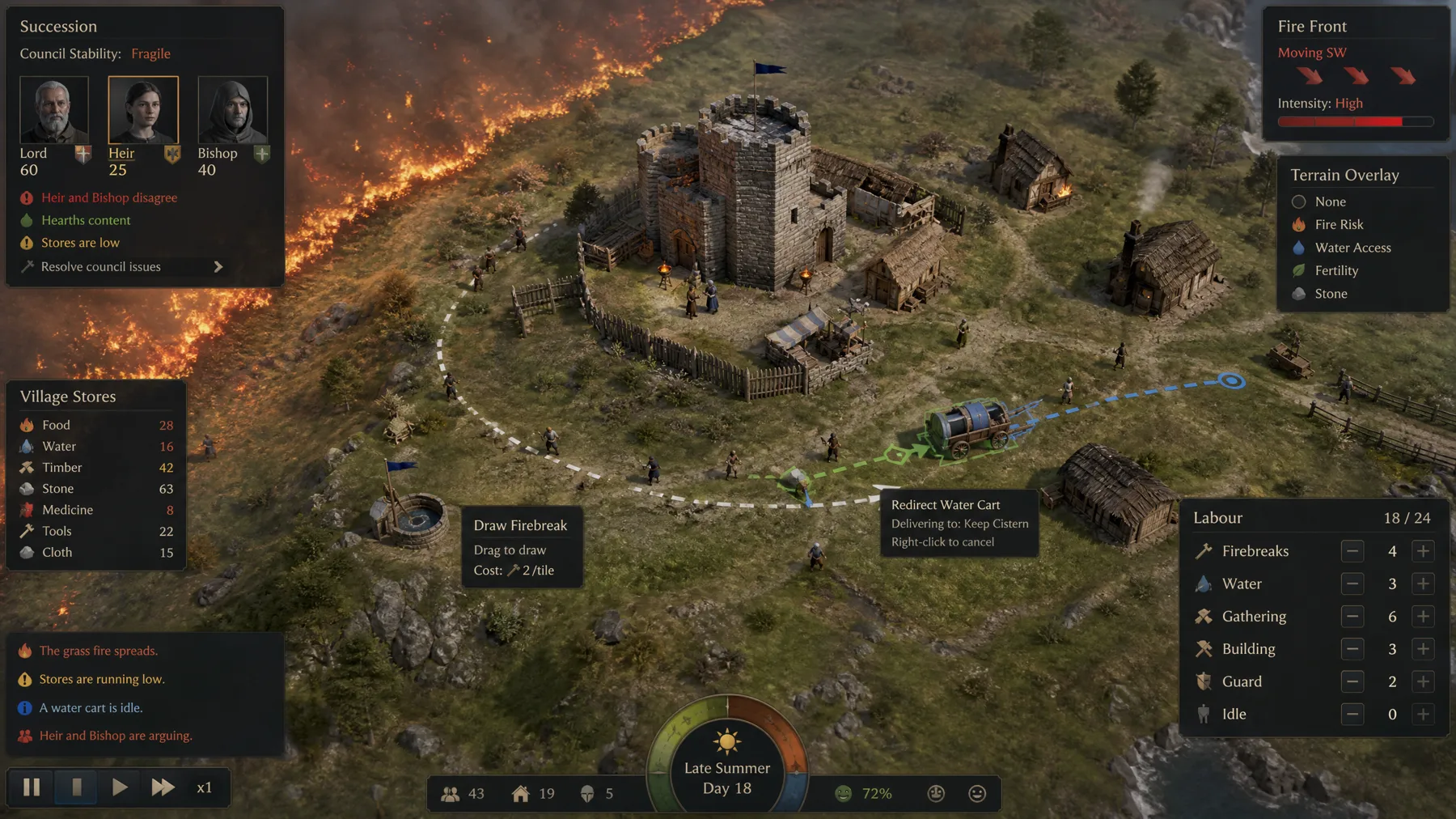
The premise is deceptively simple. You are the ruler of a small, precarious community, and your primary adversary is the environment itself. The HUD is a masterclass in minimalist design, presenting only the essential metrics: stability, stores, fire direction, labour, and the current season. Yet, within these few variables lies a dizzying array of strategic choices. The game's isometric perspective offers a clear, god-like view of your settlement, allowing you to watch as the wind shifts and the flames lick at the edges of your carefully cultivated fields. It is a beautiful, terrifying sight, rendered with a painterly aesthetic that belies the brutal calculations you must constantly make.
Fire Behaviour and the Mechanics of Sacrifice
The core mechanic of A Small Kingdom of Ash is the management of fire behaviour. The game models the spread of flames with an alarming, dynamic realism. Wind direction, humidity, and the type of vegetation all play a crucial role in how quickly a fire advances. Drawing a firebreak is your primary defence, but it is an action fraught with consequence. A firebreak requires labour, which is always in short supply. More importantly, it requires space. To stop a fire from consuming the central storehouse, you might have to deliberately burn the outlying farms, condemning a portion of your population to starvation in the coming winter.
This is where the game elevates itself from a simple resource manager to a profound political simulator. The water cart, a precious and slow-moving asset, must be redirected constantly. Do you send it to douse the flames threatening the nobility's estates, or do you protect the communal granary? Every decision impacts your stability metric. The villagers are not mindless drones; they are a volatile constituency. If you sacrifice their homes too often, stability plummets, and you risk a revolt that can be just as destructive as the fire itself.
"The fire does not care about your lineage, but your people certainly do. In the ashes, every decision is laid bare, and the cost of survival is always paid by someone else."
Succession and the Burden of Leadership
As if managing the immediate threat of immolation were not enough, the game introduces a complex succession system. Your ruler is mortal, and the stress of leadership takes a tangible toll. When a ruler dies, the transition of power is rarely smooth. You must choose an heir, and each candidate comes with their own factional loyalties and unique traits. A militaristic heir might handle revolts with ease but lack the logistical acumen to manage the village supply chains efficiently. A populist might keep stability high but refuse to make the harsh sacrifices necessary to stop a massive blaze.
Handling succession while a grass fire is actively threatening the settlement is one of the most intense experiences the game offers. The HUD's stability meter becomes a ticking time bomb. The political choices you make during these transitions dictate the long-term survival of your kingdom. Do you appease the wealthy landowners to secure immediate resources, or do you side with the labourers to ensure the firebreaks are dug in time? The game forces you to confront the reality that political capital is just as vital as physical resources.
Labour, Supply, and the Scale of Crisis
The scale of the map in A Small Kingdom of Ash is intentionally compact. You are not managing a sprawling empire; you are managing a single, vulnerable hill settlement. This intimacy amplifies the impact of every decision. When you redirect labour from the harvest to dig trenches, you feel the immediate sting of dwindling stores. The village supply chain is tightly wound, and a single disruption can cause a cascading failure.
Labour management is a constant juggling act. You must assign workers to draw firebreaks, operate the water cart, harvest crops, and maintain order. The game brilliantly intertwines these tasks. For instance, a worker exhausted from fighting fires is less productive in the fields, leading to lower yields and, subsequently, lower stability. The interconnectedness of these systems means that there are no isolated problems; a failure in one area inevitably bleeds into the others.
Controls, Performance, and Accessibility
On both PC and Switch 2, the controls are intuitive and responsive. The PC version benefits from the precision of a mouse for drawing complex firebreaks and quickly selecting units, but the Switch 2 adaptation is remarkably elegant. The developers have mapped the camera controls and unit selection to the thumbsticks and triggers in a way that feels natural, ensuring that the frantic pace of the game is never hindered by clumsy inputs.
Technical performance is robust across both platforms. The dynamic fire rendering, which could easily bring lesser hardware to its knees, runs smoothly even when the screen is engulfed in flames. The Switch 2 version maintains a steady frame rate, which is crucial when split-second decisions are required to redirect the water cart or issue emergency evacuation orders. The visual clarity of the isometric art style ensures that you can always parse the chaotic battlefield, even in handheld mode.
Accessibility has also been thoughtfully addressed. The game includes options to adjust the speed of the fire spread, allowing players to tailor the difficulty to their preferences. There are comprehensive colour-blind modes that ensure the vital information on the HUD remains legible. The inclusion of scalable text and remappable controls further cements the developer's commitment to making this intense experience available to a wide audience.
The Verdict: A Masterpiece of Micro-Management
A Small Kingdom of Ash is a triumph of focused game design. It takes a terrifying natural disaster and uses it as a crucible to test your political and logistical acumen. The interplay between fire behaviour, labour management, and succession creates a deeply engaging loop of crisis and resolution. It is a game that understands that the most difficult decisions are not made on a grand, abstract scale, but in the muddy, ash-choked fields of a small settlement fighting for its life.
| Criterion | Grade | Notes |
|---|---|---|
| Gameplay Systems | Excellent | Deeply interconnected mechanics that reward foresight and adaptability. |
| Visuals & Audio | Great | Painterly aesthetics paired with a tense, atmospheric soundscape. |
| Performance | Solid | Runs flawlessly on both PC and Switch 2, even during intense fire sequences. |
| Accessibility | Good | Thoughtful options for difficulty and visual clarity. |
With a score of 8.5, it stands as one of the most compelling strategy games of the year. It proves that you do not need a sprawling map or a cast of thousands to create a profound and challenging experience. Sometimes, all you need is a hill, a spark, and the impossible burden of deciding who gets to stand behind the firebreak.