
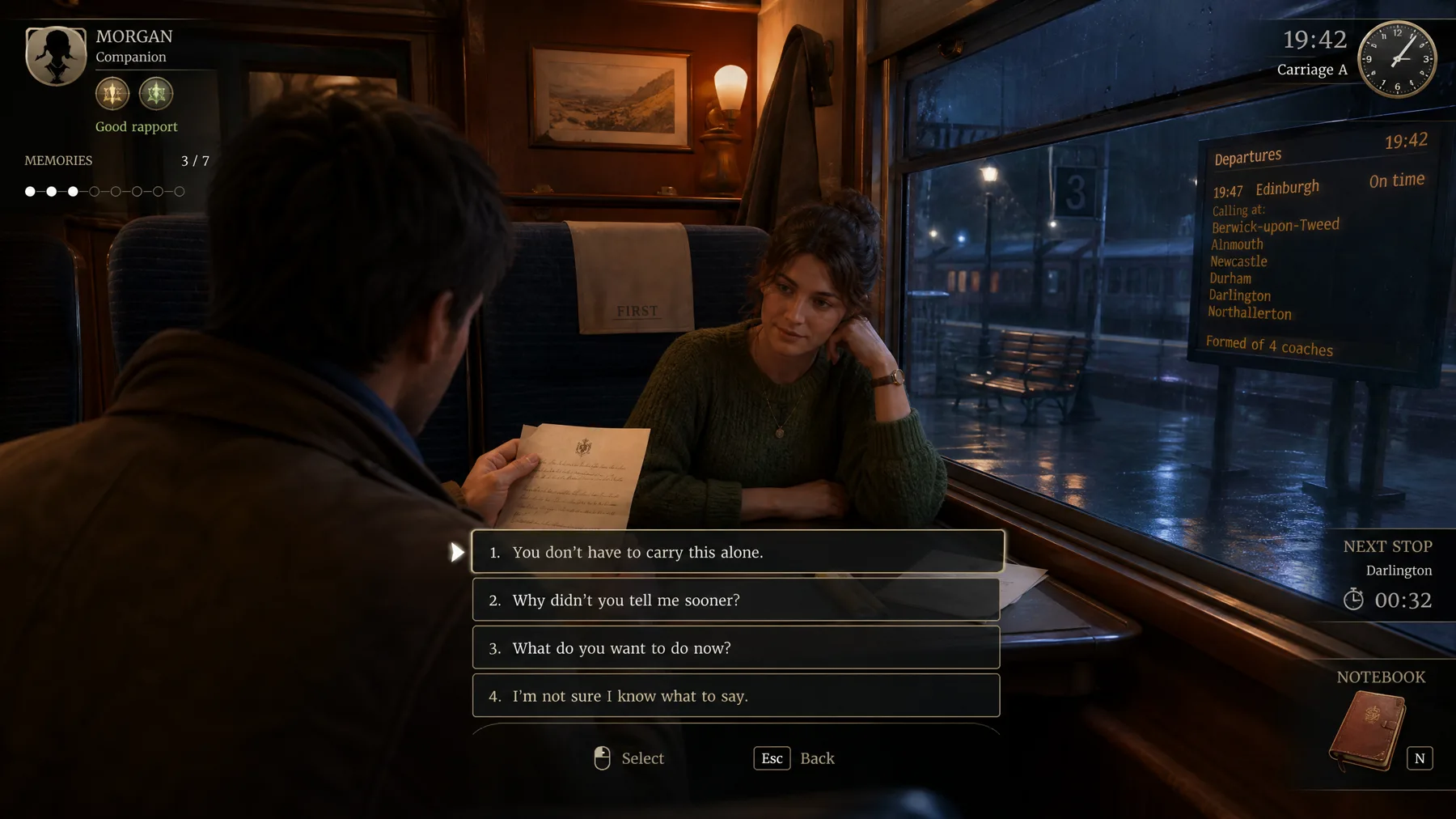
The rhythmic clatter of iron wheels on steel tracks forms the steady heartbeat of Northbound Letters, a narrative role-playing game that marries the quiet intimacy of a railway journey with the relentless pressure of a strict timetable. Set entirely within the confined, wood-panelled carriages of a vintage overnight express, the game presents a deceptively simple premise: you are a lone passenger holding a single, mysterious letter, engaging in complex conversations with a diverse and guarded cast of fellow travellers. Yet, beneath this tranquil exterior lies a labyrinthine web of dialogue memory, intricate relationship management, and strict temporal constraints that elevate the experience far beyond the trappings of a conventional visual novel.
A Memory Etched in Steam and Ink
At the core of the game lies its extraordinary dialogue memory system. Every choice you make, every offhand remark, and every withheld piece of information is meticulously catalogued by the game's underlying mechanics. When you sit across from a stranger in the dimly lit evening carriage, the HUD elegantly displays four potential responses to your current conversational partner, but it also reveals much more. Hovering gently at the periphery of the screen are your 'relationship memories'—fragmented echoes of past interactions that dynamically influence the current dialogue options. If you previously feigned ignorance about a character's profession, the game remembers, and your subsequent choices will be rigidly bound by that established deception. It is a system that demands absolute consistency and rewards careful attention to detail.
The sheer depth of this memory system becomes apparent when you attempt to manipulate the passengers. A lie told in the dining car might not be challenged until hours later in the observation lounge, and the consequences of being caught in a falsehood can be devastating.
The Relentless March of the Timetable
While the dialogue system provides the intellectual challenge, the timetable provides the palpable tension. A prominent carriage clock ticks away in the corner of the screen, a constant reminder that your time with these passengers is strictly finite. The journey is punctuated by scheduled stops, each acting as a hard boundary for your current interactions. If you spend too much time exploring the dining car or lingering aimlessly in the observation lounge, you may entirely miss the fleeting opportunity to confront a crucial character before they disembark forever at a desolate midnight station.
You must constantly weigh the potential value of deepening a relationship against the ticking clock, deciding whether to press for more information, risking alienation, or politely excuse yourself to pursue another lead. The anxiety of watching the minutes slip away while a character prevaricates is a masterstroke of game design, perfectly simulating the panic of a closing window of opportunity.
Exploration and the Tactile Carriage
Exploration within the carriages themselves is handled with a tactile, deliberate grace. The environments are richly detailed, from the condensation trickling down the windows to the worn upholstery of the seats and the polished brass fittings of the doors. Moving between carriages requires navigating narrow corridors, occasionally eavesdropping on hushed conversations through partially closed doors, and observing the subtle shifts in atmosphere as you move from the raucous bar car to the hushed silence of the sleeper compartments.
This spatial awareness is absolutely crucial, as characters move about the train according to their own distinct schedules and hidden agendas, requiring you to actively hunt down conversations rather than passively waiting for them to come to you.
Cultivating Connections in Transit
The relationships you forge in Northbound Letters are beautifully nuanced and constantly shifting. The characters are not static archetypes waiting patiently to dispense exposition, but fully realised individuals with their own complex agendas, deeply held secrets, and profound vulnerabilities. The notebook feature in your HUD becomes an indispensable tool, automatically updating with key revelations, suspected motives, and potential lines of inquiry. Building trust is a slow, deliberate process, frequently requiring you to share fragments of your own mysterious letter to elicit reciprocal honesty.
Conversely, alienating a passenger through clumsiness or overt aggression can lock off entire branches of the narrative, forcing you to find alternative routes to the truth.
The Structure of Replayability
Because the journey is strictly bound by the unyielding timetable, it is physically impossible to uncover every secret or follow every lead in a single playthrough. The replay structure is explicitly designed to encourage multiple journeys along the same tracks. Each complete run reveals new layers of the overarching mystery, allowing you to approach subsequent playthroughs with a broader understanding of the passengers' hidden motives.
Controls, Performance, and Accessibility
Navigating this intricate web of dialogue and time management is facilitated by a remarkably intuitive control scheme. On both PC and consoles, the interface is clean and unobtrusive, allowing the stunning art direction to rightfully take centre stage. Selecting dialogue options, consulting the notebook, and moving fluidly between carriages feel natural and responsive, never hindering the player's immersion.
From a technical standpoint, Northbound Letters is largely exemplary. The PC version runs flawlessly, with the atmospheric lighting and subtle character animations rendering beautifully even on relatively modest hardware. The console ports are similarly robust, maintaining a rock-steady frame rate that preserves the cinematic quality of the experience.
Accessibility has also been thoughtfully addressed. The game features highly customisable text options, including scalable fonts and high-contrast modes, ensuring that the dialogue-heavy gameplay is legible for all players. Furthermore, an optional 'relaxed timetable' mode can be toggled, slightly extending the crucial time between stations for those who prefer to focus entirely on the narrative nuances without the constant pressure of the ticking clock.
The Final Verdict
Northbound Letters is a masterclass in focused narrative design. By boldly constraining its scope to a single train journey and imposing strict temporal limits, it creates a profoundly intimate and engaging role-playing experience. The dialogue memory system is genuinely innovative, forcing players to consider the long-term consequences of their every word, while the rich presentation makes every carriage feel alive with hidden possibility. It is a game that deeply respects the player's intelligence and handsomely rewards patience, keen observation, and genuine empathy.
"A profoundly intimate and engaging role-playing experience that makes every carriage feel alive with possibility and unspoken danger."
Review Summary
| Category | Assessment |
|---|---|
| Gameplay | Innovative dialogue memory and tense timetable mechanics create a uniquely compelling loop. |
| Narrative | Nuanced characters and a brilliantly layered, replayable mystery ensure lasting engagement. |
| Technical | Flawless performance across platforms with a stunning, deeply atmospheric presentation. |
| Accessibility | Comprehensive text options and a welcome 'relaxed' mode accommodate a wide variety of needs. |
In an era increasingly dominated by sprawling open-world epics, Northbound Letters proves definitively that sometimes the most memorable journeys are those confined to a few wood-panelled carriages hurtling blindly through the night. It is a quiet, resounding triumph, a game that lingers in the memory long after the final stop has been reached.