
Downriver Club review: Rhythm is a budget decision
Rowing, at its highest competitive level, is a sport of brutal synchronicity. It demands a mechanical precision that borders on the obsessive, where the slightest deviation in stroke rate can spell disaster for an entire crew. Downriver Club, the latest management simulation to grace the PC and PS5, understands this fundamental truth intimately. It is a game not just about the physical exertion of propelling a boat through water, but about the meticulous orchestration of human effort, financial resources, and tactical foresight. In an overcrowded market of sports management titles, Downriver Club carves out a niche that feels both refreshing and intensely demanding, capturing the essence of competitive rowing with a surprisingly deft touch.
The Financial Undertow
At the heart of the experience lies the unglamorous reality of amateur and semi-professional sports: money. Your tenure as the manager of a fledgling rowing club begins not on the water, but in the sterile environment of a spreadsheet. Budgets are perpetually tight, and every expenditure must be ruthlessly justified. The decision to invest in a state-of-the-art carbon fibre eight-person shell versus upgrading the club's dilapidated indoor ergometers is a constant balancing act. Equipment degradation is a tangible, ever-present threat; boat wear accumulates over the season, subtly altering hydrodynamics and race times. You must decide whether to patch up an ageing vessel with fibreglass or take out a high-interest loan for a new one—a choice that reverberates through every aspect of your club's morale and performance.
Cultivating Crew Rhythm
Once the financial foundations are somewhat stabilised, the focus inevitably shifts to the athletes themselves. Training in Downriver Club is a granular, demanding affair, requiring you to balance aerobic endurance, anaerobic capacity, and raw technical skill. But the most critical metric by far is crew rhythm. You cannot simply throw your eight strongest rowers into a boat and expect victory. The game simulates the delicate interpersonal dynamics and physical synchronisation required to make a boat glide effortlessly. Pairing a powerful but erratic stroke seat with a meticulous but physically weaker bow can disrupt the entire rhythm, leading to splashed oars and dropped seconds. Finding the perfect combination of athletes, and nurturing their collective timing through gruelling early-morning sessions, is immensely satisfying when it finally clicks.
Tactical Race Day
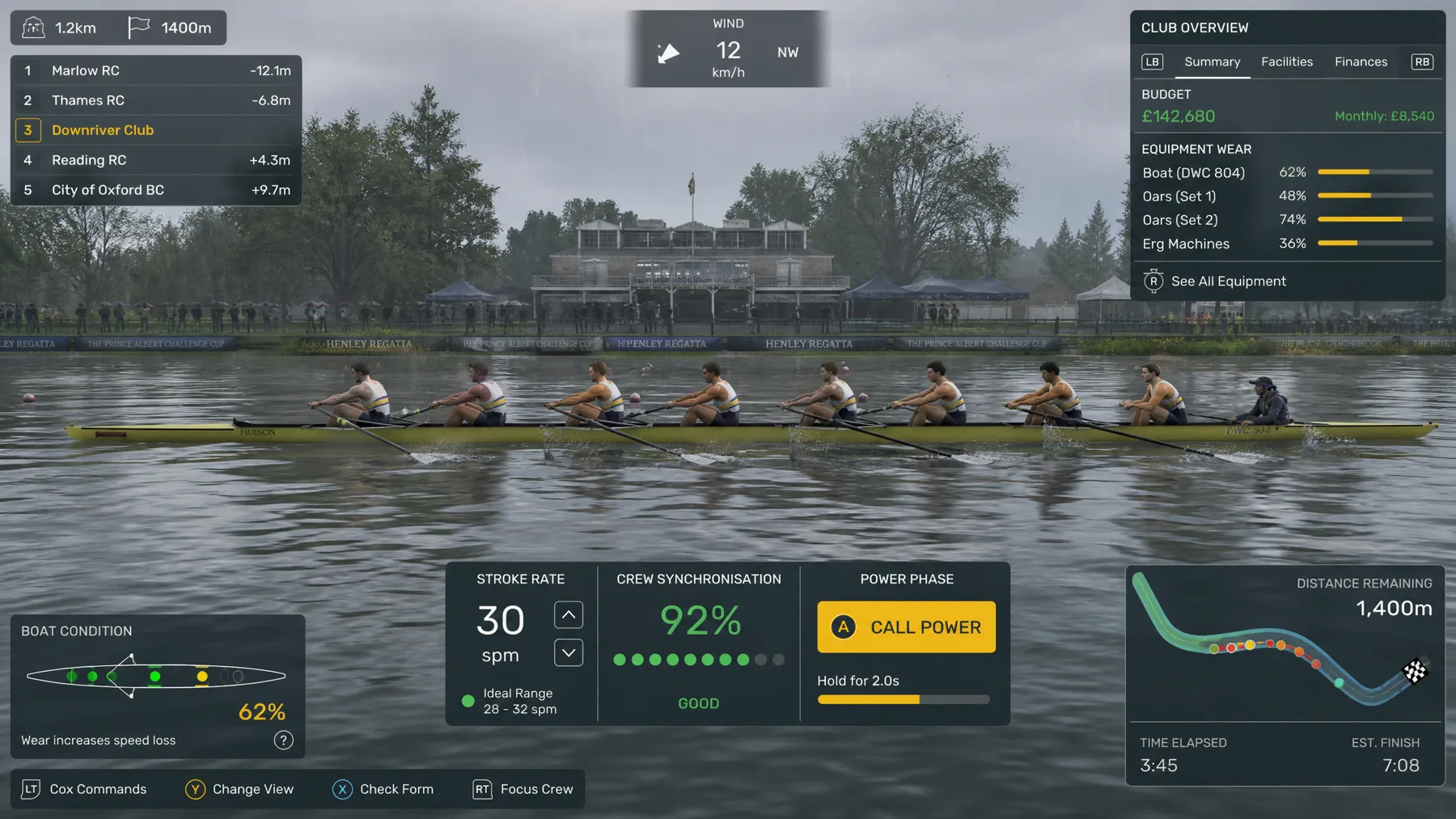
When race day arrives, the perspective shifts dramatically to a tactical, top-down view of the river. The visual representation is stark but highly informative, stripping away unnecessary visual clutter to focus on the data. You watch your eight-person shell slice through the water, surrounded by a comprehensive Heads-Up Display that feeds you real-time telemetry. The HUD is a masterclass in information design, clearly displaying the crew's current stroke rate, their overall synchronisation percentage, wind direction and speed, boat wear indicators, distance to the finish line, and the relative positions of rival crews. It is here that the game's core image is most vividly realised: a clinical, data-driven perspective on a deeply physical contest, where you must interpret a flurry of numbers to make split-second decisions that will determine the outcome of the race.
Weathering the Storm
The river is a dynamic, unpredictable entity, and weather plays a pivotal role in every regatta. A sudden, biting headwind will force you to adjust your race strategy on the fly, perhaps calling for a lower, more powerful stroke rate to punch through the gusts without exhausting your crew. Conversely, a favourable tailwind might present a fleeting opportunity to increase the cadence and go for an early lead. As the manager and de facto coxswain, you issue race calls to your crew in real-time. These commands cost stamina and must be timed with absolute perfection. Calling for a sprint too early will leave your crew exhausted and vulnerable in the final stretch, while waiting too long might mean failing to close the gap on a rival boat before the finish line.
Control Schemes and Accessibility
Translating a complex management simulation to a console controller is often a fraught endeavour, but Downriver Club handles the transition with admirable elegance. On the PC, the mouse and keyboard interface is naturally intuitive, allowing for rapid navigation of dense menus and precise clicking during the chaotic moments of a race. However, the PS5 version holds its own thanks to a clever radial menu system and sensible mapping of shortcuts to the DualSense controller's triggers and bumpers. Navigating the complexities of the training schedule or the budget screen feels snappy, and issuing race calls via the D-pad during the heat of a regatta becomes second nature.
Accessibility is another area where Downriver Club makes a commendable effort. The game features a comprehensive suite of options designed to tailor the experience to individual needs. Text size can be scaled generously without breaking the UI, and the colour palette of the HUD can be adjusted to accommodate various forms of colour blindness. Furthermore, the game allows you to automate certain granular management tasks, enabling players to focus purely on the broader financial strategy or the visceral excitement of race day. This flexibility ensures that the notoriously steep learning curve of management simulations is significantly flattened.
Technical Performance
From a technical standpoint, Downriver Club is a solid, if unspectacular, performer. The graphics are deliberately utilitarian, prioritising clarity and readability over visual flair. The water physics are competent, accurately reflecting the impact of weather and the turbulent wake of competing boats. This visual restraint ensures that the game runs flawlessly. On both PC and PS5, the frame rate remains locked, and loading times are practically non-existent. In a game where timing and rapid data analysis are paramount, this unwavering technical stability is far more valuable than high-resolution textures.
"It is a game not just about the physical exertion of propelling a boat through water, but about the meticulous orchestration of human effort, financial resources, and tactical foresight."
Verdict and Scoring
Downriver Club is a proudly niche title that knows its audience and caters to them with impressive depth and mechanical rigour. It captures the true essence of competitive rowing—the brutal synchronisation, the tactical nuance, the sheer physical toll—and translates it into a deeply compelling management experience. It asks you to care passionately about stroke rates and boat wear, to stress over spreadsheets and weather forecasts, and it rewards that emotional investment with a profound sense of accomplishment.
| Criterion | Grade | Notes |
|---|---|---|
| Gameplay | Excellent | Deep, rewarding management systems coupled with tense, tactical races. |
| Presentation | Good | Utilitarian but clear, with an exceptionally well-designed HUD. |
| Performance | Excellent | Flawless execution on both platforms, prioritising stability over flash. |
| Accessibility | Great | Strong options for UI scaling, colour blindness, and task automation. |
Verdict: Downriver Club is a meticulous and deeply satisfying management simulation that captures the brutal rhythm of competitive rowing. While its pacing can occasionally falter, the sheer depth of its systems and the tension of race day make it a triumph for fans of the genre.
Score: 8.4/10