
The Resonance of Fear
There is a distinct, metallic finality to the ringing of a school bell. In most contexts, it signals the end of a lesson, but in The Third Bell at Harton, it heralds something far more sinister. This survival horror title, available on PC and consoles, transforms the mundane architecture of a secondary school into a labyrinth of auditory terror. By anchoring its mechanics to sound tracking and a rigid temporal schedule, it crafts an atmosphere that is as suffocating as it is meticulously designed.
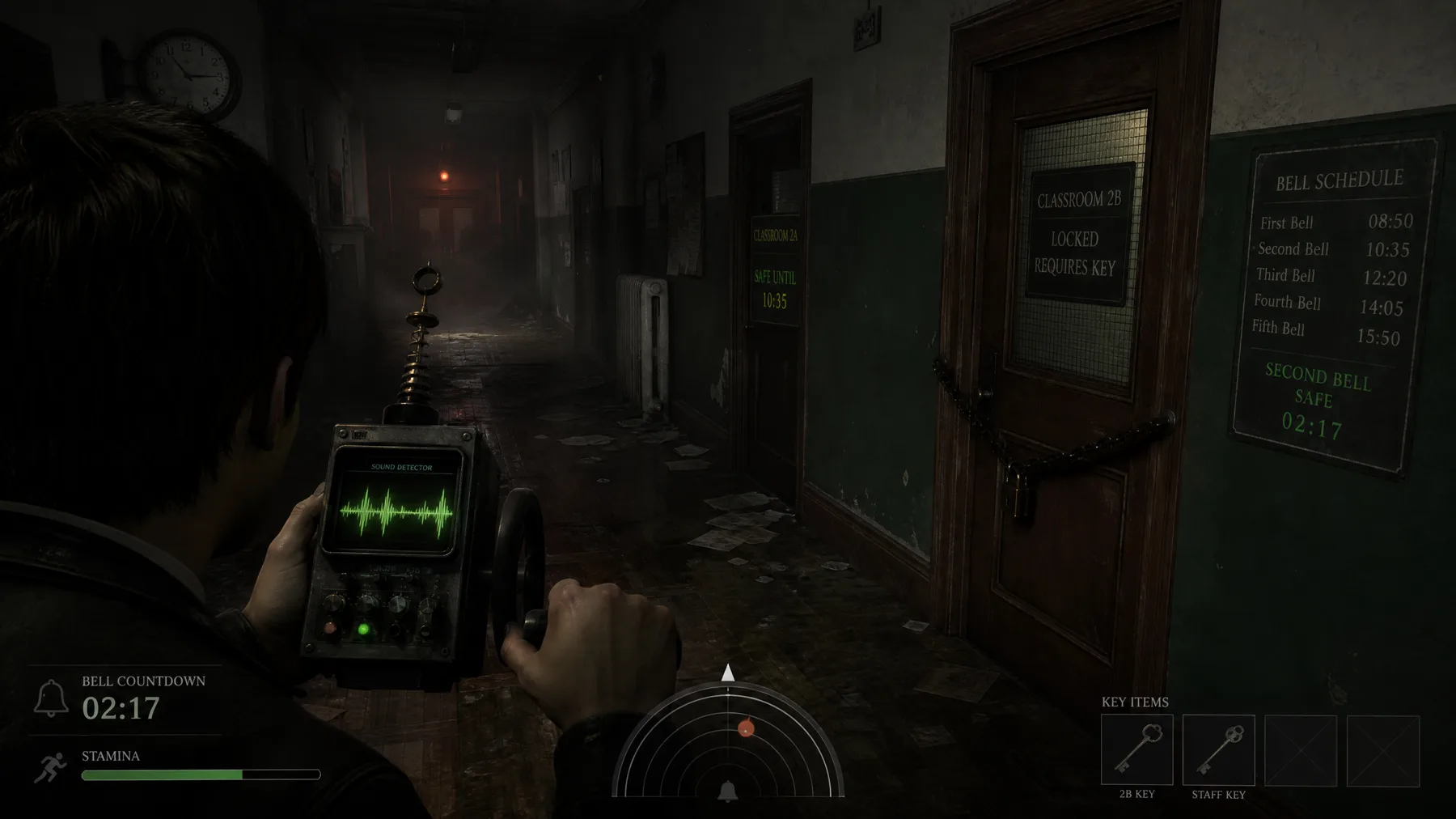
The premise is elegantly simple: you are trapped within the locked corridors of Harton Academy, armed with little more than a hand-cranked sound detector and your own wits. The game adopts an over-the-shoulder perspective, placing you uncomfortably close to the protagonist's vulnerability. The heads-up display is a masterclass in minimalist tension, presenting only what is strictly necessary: a jagged waveform for your detector, a relentless bell countdown, a stamina bar, your collected keys, and a faint directional indicator. It demands your constant attention, ensuring you are never quite at ease.
The Bell Schedule and Temporal Tension
At the heart of the experience is the bell schedule, a mechanic that dictates the rhythm of your survival. The game operates on a strict timetable, with each bell altering the state of the school and the behaviour of its unseen occupants. The first bell might unlock a previously inaccessible wing, while the second could plunge the corridors into darkness. The titular third bell, however, is the catalyst for true panic. When it rings, the environment shifts, and the pursuit intensifies. This temporal structure forces players to constantly evaluate their progress against the ticking clock, transforming every decision into a calculated risk.
You cannot simply wait out the terror. The countdown on your HUD is a constant reminder that time is a resource as precious as the batteries in your torch. If you find yourself caught in the open when the schedule shifts, the consequences are invariably dire. This system encourages a methodical approach to exploration, rewarding those who plan their routes and memorise the layout of the school's various wings.
Sound Tracking and the Hand-Cranked Detector
The most innovative tool at your disposal is the hand-cranked sound detector. In a genre that often relies on visual jump scares, The Third Bell at Harton places a premium on auditory awareness. The device captures ambient noise, translating it into a waveform on your screen. However, it is not a passive instrument. Cranking the handle generates its own noise, a rhythmic grinding that can mask the subtle footsteps of your pursuers or, worse, draw their attention.
This creates a brilliant risk-reward dynamic. To locate the source of a threat or uncover a hidden path, you must use the detector, but doing so compromises your own stealth. The audio design here is nothing short of exceptional. The creak of floorboards, the distant slamming of a locker, and the heavy, ragged breathing of the entities hunting you are rendered with chilling clarity. You learn to interpret the waveform, distinguishing between the ambient settling of the old building and the deliberate movements of a predator.
Navigating the School Wings
Harton Academy is divided into distinct wings, each with its own architectural character and specific hazards. The Science Block, with its shattered glass and chemical spills, requires careful footing to avoid creating noise. The Humanities Wing, lined with towering bookshelves, offers ample hiding spots but severely limits your line of sight. The game forces you to adapt your strategies to the environment, ensuring that the tension never entirely dissipates.
Exploration is gated by a traditional key-hunting system, but it is executed with enough flair to avoid feeling entirely derivative. Finding a safe room—a rare sanctuary where the bell schedule is temporarily suspended—provides a fleeting moment of respite. These rooms allow you to organise your meagre inventory and consult your mental map of the school, but the knowledge that you must eventually step back into the corridors ensures that the relief is always short-lived.
Pursuit and Resource Management
When the inevitable happens and you are spotted, the game shifts from methodical stealth to frantic pursuit. The entities that stalk the halls of Harton are relentless, and your options for self-defence are practically non-existent. You can run, but your stamina bar depletes rapidly, and the sound of your sprinting footsteps will only draw more attention. Hiding is your best recourse, slipping into a locker or beneath a desk and praying that your pursuer moves on.
Resource management is equally unforgiving. The hand-cranked detector does not require batteries, but other essential items—such as chalk for marking doors or bandages for minor injuries—are exceedingly rare. You are constantly forced to make difficult choices: do you use your last piece of chalk to mark a dead end, or save it for a potentially more confusing section of the map? This scarcity reinforces the sense of vulnerability that permeates every aspect of the game.
Controls, Performance, and Accessibility
From a technical standpoint, The Third Bell at Harton is a robust piece of software. The controls are deliberately weighty, reflecting the protagonist's lack of combat training. The over-the-shoulder camera can occasionally feel claustrophobic, particularly in the narrower corridors, but this seems to be an intentional design choice rather than a flaw. Moving, crouching, and operating the sound detector feel intuitive, though the panic of a pursuit can lead to fumbled inputs—a feature that arguably enhances the realism of the experience.
Performance on both PC and current-generation consoles is largely stable. The game targets a smooth framerate, which is crucial for a title that relies so heavily on precise timing and quick reactions. The lighting engine deserves special mention, casting long, unsettling shadows that play tricks on the eyes. However, there are occasional texture pop-ins when transitioning between major wings, though these are minor blemishes on an otherwise polished presentation.
Accessibility options are commendable for a game of this scale. The developers have included extensive audio visualisers for deaf or hard-of-hearing players, ensuring that the crucial sound-tracking mechanics translate effectively to visual cues on the HUD. Additionally, there are toggles for motion blur, customisable subtitle sizes, and remappable controls, making the nightmare of Harton Academy accessible to a broader audience.
The Final Verdict
Survival horror is a genre defined by its constraints, and The Third Bell at Harton understands this perfectly. By stripping away conventional weaponry and focusing entirely on auditory evasion and temporal pressure, it delivers an experience that is deeply unsettling. The hand-cranked sound detector is a triumph of game design, forcing players to actively engage with the environment rather than passively observing it.
| Criterion | Grade |
|---|---|
| Atmosphere & Audio Design | Outstanding |
| Gameplay Mechanics | Excellent |
| Level Design | Very Good |
| Technical Performance | Good |
A masterclass in auditory tension, proving that what you cannot see is often far more terrifying than what you can. The third bell will ring in your ears long after you have put the controller down.
Score: 8.6/10
An exceptional survival horror experience that leverages sound and time to create a suffocating atmosphere. Essential playing for genre enthusiasts who appreciate a more cerebral approach to terror.