
A Tangled Web of String and Supposition
There is a distinct, almost tactile satisfaction in pinning a piece of evidence to a corkboard and drawing a taut red string to a suspect’s photograph. Copper & Rain, the latest detective investigation thriller to arrive on PC and PlayStation 5, understands this visceral thrill implicitly. It eschews the modern trend of automated deduction and objective waypoints, instead thrusting players into a dimly lit precinct where intuition, meticulous cross-referencing, and a healthy dose of scepticism are your only reliable tools. In a genre often plagued by hand-holding, this title demands genuine cognitive engagement, presenting a world where an evidence board can, and often will, mislead you if you allow confirmation bias to take root.
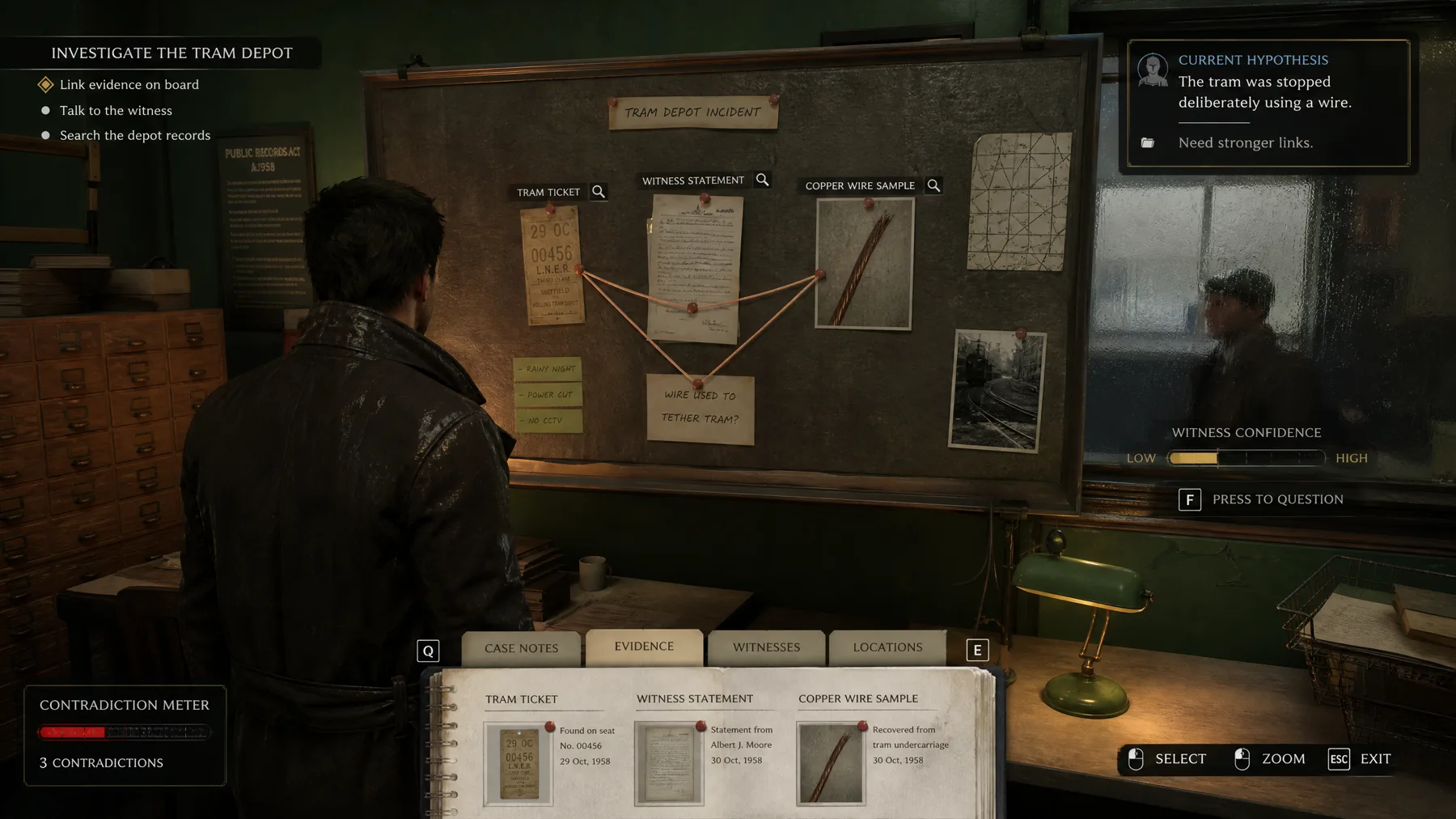
The core experience revolves around the analogue evidence board, a physical space rather than a mere menu screen. During one harrowing case, you might find yourself staring at a seemingly disparate collection of items: a crumpled tram ticket, a hastily scribbled witness statement, and a frayed length of copper wire. The mechanics of linking these elements are delightfully robust. The HUD elegantly displays your current links, highlighting potential contradictions and tracking your overall confidence level in a given hypothesis. It is a system that rewards careful reading and logical leaps, but it is equally quick to punish careless assumptions. When a link is made, the game does not immediately confirm its validity; instead, it simply records your thought process in your notebook, leaving you to test the theory against the harsh reality of the interrogation room.
The Art of the Interrogation
Speaking of interrogations, Copper & Rain handles its cast with nuance. The image of a suspect waiting anxiously behind the glass of an observation room is a recurring motif, and the ensuing conversations are masterclasses in tension. Witnesses in this game are inherently unreliable. They lie to protect themselves, misremember crucial details due to trauma, or simply offer red herrings out of sheer ignorance. The challenge lies in parsing the truth from the obfuscation, using the evidence you have painstakingly gathered to expose contradictions in their testimonies.
The hypothesis system is deeply integrated into these encounters. Before stepping into the room, you must formulate a clear hypothesis in your notebook, based on the links on your board. This hypothesis dictates the flow of the interrogation, opening up specific dialogue avenues while closing off others. If you enter the room with a flawed theory, the suspect will quickly poke holes in your logic, causing your confidence meter to plummet and potentially derailing the investigation entirely. It is a high-stakes game of intellectual poker, where presenting the copper wire at the wrong moment can cause a suspect to clam up, whilst revealing the tram ticket precisely when their alibi wavers can lead to a dramatic, satisfying confession.
Consequences and Branching Narratives
What elevates Copper & Rain above its peers is its commitment to case branching. The game does not force you down a linear path toward a single truth. If you misinterpret the evidence, accuse the wrong individual, or fail to uncover a crucial piece of the puzzle, the narrative adapts. Cases can be closed with the wrong person behind bars, and the repercussions of these failures ripple outwards, affecting your reputation and altering resource availability in subsequent investigations.
This branching structure adds tremendous replayability, but also instils a profound sense of responsibility. Knowing that a botched interrogation or a flawed deduction on the evidence board can lead to a miscarriage of justice makes every decision feel weighty. The game rarely tells you when you have made a mistake until it is too late, forcing you to live with the consequences of your shortcomings. It is a bold design choice that reinforces the gritty tone of the narrative.
Tactile Controls and Atmospheric Presentation
Navigating this complex web of intrigue requires a control scheme that is both intuitive and precise, and the developers have largely succeeded on this front. On the PlayStation 5, the DualSense controller is utilised to great effect. The haptic feedback provides a subtle, satisfying resistance when pinning items to the board or drawing string between them, enhancing the tactile nature of the mechanics. On PC, the mouse and keyboard setup is equally adept, allowing for swift navigation of the notebook and precise manipulation of the evidence board. The interface is clean and unobtrusive, ensuring that the focus remains squarely on the investigation rather than wrestling with cumbersome menus.
Visually, the game is a masterclass in atmospheric design. The precinct is a study in neo-noir aesthetics, with sharp shadows, flickering fluorescent lights, and the pervasive sound of rain lashing against the windows. The character models are highly detailed, with subtle facial animations that are crucial for reading tells during interrogations. A slight twitch of the eye or a nervous swallow can be just as revealing as a spoken contradiction. The audio design further heightens the immersion, with a moody, jazz-inflected soundtrack that swells during moments of revelation and fades into a tense pulse during high-stakes interrogations.
Performance and Accessibility
From a technical standpoint, Copper & Rain performs admirably across both platforms. The PlayStation 5 version maintains a rock-solid framerate, even when the evidence board is cluttered with dozens of items and intricate webs of string. Load times are practically non-existent, allowing for seamless transitions between the precinct, the interrogation room, and the various crime scenes. The PC version is similarly well-optimised, offering a suite of graphical options that scale well across hardware configurations.
Accessibility has also been carefully considered. The game features comprehensive subtitle options, including adjustable sizes, colours, and background opacity, ensuring that the dialogue-heavy narrative is accessible to all. Furthermore, there are options to adjust the difficulty of the deduction mechanics, allowing players to tailor the experience to their preferred level of challenge. For those who find the visual clutter of the evidence board overwhelming, a high-contrast mode can be toggled to highlight key items and links, ensuring that the core investigative gameplay remains approachable without sacrificing its inherent complexity.
Verdict
Copper & Rain is a triumph of investigative game design. By trusting the player's intelligence, it delivers an experience that is as intellectually demanding as it is narratively gripping. The analogue evidence board is a revelation, transforming deduction into a tangible, satisfying mechanic. While the volume of variables and the potential for failure may prove daunting, those willing to embrace the challenge will find a deeply rewarding detective simulator. It is a game that understands the truth is rarely simple, and that even the most meticulously constructed evidence board can still mislead you if you are not careful.
A gripping, meticulously crafted detective experience that demands your full intellectual investment. The tactile nature of the evidence board and the high-stakes interrogations make every deduction feel hard-earned and profoundly satisfying.
VEXONIREL Magazine Assessment
| Criterion | Grade | Notes |
|---|---|---|
| Gameplay Systems | Excellent | The analogue board and hypothesis mechanics are genre-leading. |
| Narrative & Branching | Outstanding | Consequential decisions with meaningful, sometimes harsh, outcomes. |
| Presentation | Great | Atmospheric neo-noir visuals and superb facial animations. |
| Performance | Solid | Smooth framerates and fast loading on both PC and PS5. |
Final Score: 8.9/10